


Fishpond
Rybniště is a scattered village located in a saddle between Široký vrch and Plešivec, about 3 km northeast of Chřibská.
Fragments of history
The oldest part of the village is Chřibská Nová Ves, which was first mentioned in 1475. The village originally belonged to the Tolštejn estate, but in 1573 Kryštof of Šlejnice sold it, along with Krásná Lípa and part of Horní Podluží, to the brothers Jindřich and Abraham of Vartenberk, who annexed it to the České-Kamenice estate. The name of the village appears in 1715, when the settlement Rybniště is mentioned on the site of a drained and dried pond. It merged with Chřibská Nová Ves and probably since 1805 it has been listed as the village of Rybniště /Teichstatt/, Varnsdorf district. Because in the 1880s Rybniště already had over 1,100 inhabitants, while Chřibská Nová Víska only had about 470, the municipal office was established in Rybniště and Chřibská Nová Víska became its settlement in 1890.
The local inhabitants initially made their living from agriculture and later mainly from the production of cotton goods and yarn. In the second half of the 19th century, there were several bleaching plants and the textile industry gradually expanded. The development of the village was also contributed by the railway, which was put into operation in January 1869. An important railway station was built right in Rybniště, from which the lines to Rumburk and Varnsdorf diverge. The village also includes the Chřibská station hidden in the forests with a sawmill and the former resort of Malý Semerink.
In 1980, Rybniště was annexed to Chřibská, but in 1990 it again became an independent municipality.
The village and its surroundings are interwoven with a network of marked, uncrowded cycling routes, but you can also set off from here to nearby Bohemian Switzerland, the Lusatian Mountains, or even Germany. Whichever side of the world you choose, you will always find something interesting there. The local peace and quiet will allow you to recharge your batteries and take a break from the crowds of tourists.
What you should see
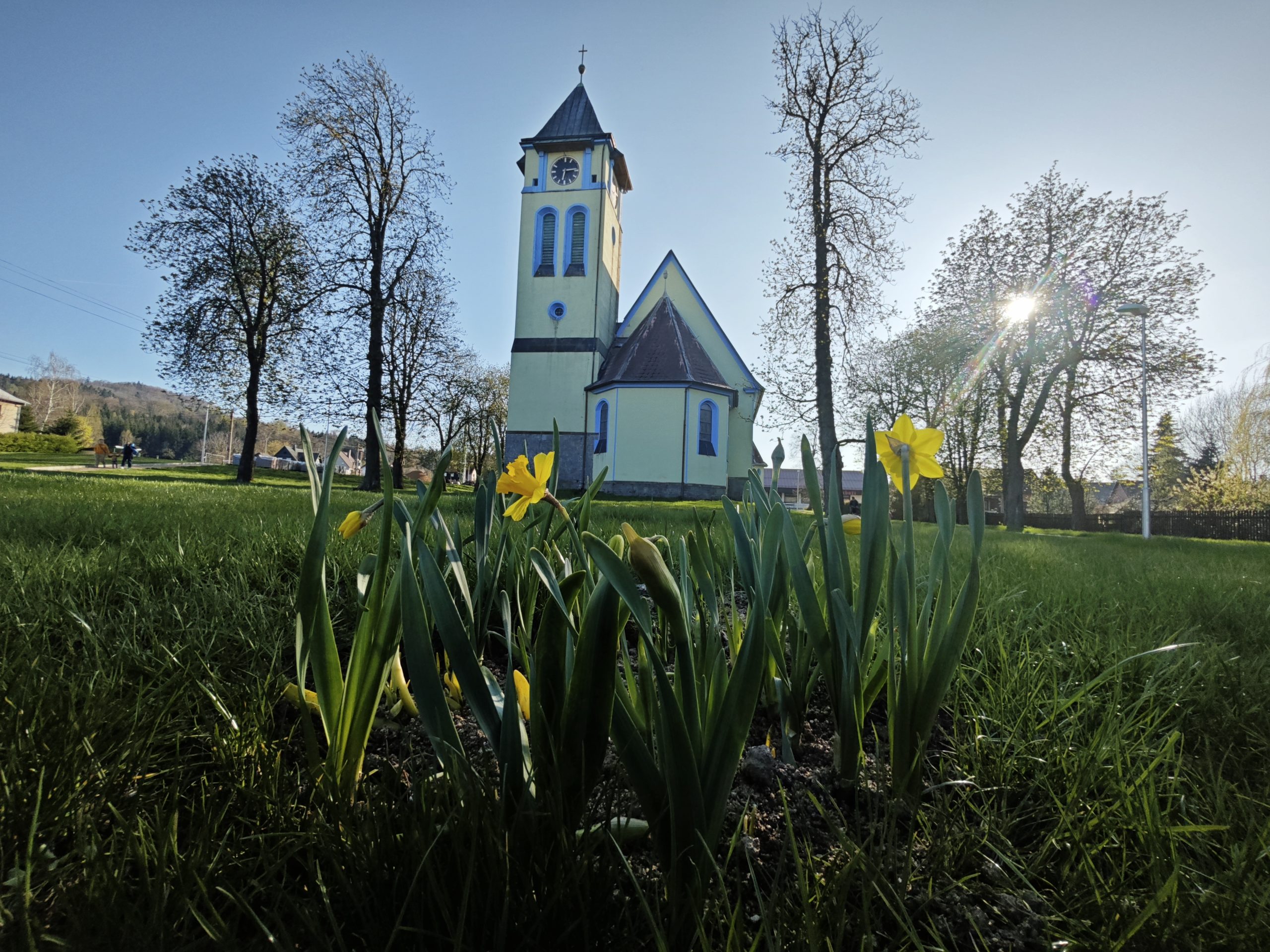
Church of St. Joseph
On June 29, 1911, the Church of St. Joseph in Rybniště was solemnly consecrated by the then Bishop Josef Gross. The construction of the church was entrusted to the Varnsdorf builder Anton Möller. The main sponsor was the Society of St. Boniface in Prague-Emauzy. The Church of St. Joseph is a fine example of Art Nouveau sacral architecture, of which there are not many. However, it has its counterpart in Mokřiny u Aše. The church was renovated according to the possibilities of the time in 1989-1990. On May 22, 2004, two new bells, St. Joseph (615 kg – tone as1) and St. Boniface (280 kg – tone des1), were blessed, which supplemented the old bell of St. Hermann (360 kg – tone b1) from 1926 in the bell tower. It received its typical colorful coat in 2011 during the celebration of 100 years since the ceremonial consecration.
The Three Kings Chapel
is located in the Na sedle part of the village, on the marked road to Chřibská. The slender, relatively tall white-plastered chapel has the year 1775 on its gable and a painted scene of the Adoration of the Three Kings is in a glazed niche. This chapel, together with the nearby Parish Chapel, stood on the old Church Path, along which the inhabitants of Krásná Lípa used to walk to the church in Chřibská during the re-catholicization in the years 1651-1724.
High Baroque column with the sculpture of the Holy Trinity
The column is located on the wheelchair route between Krásná Lípa, part of Rybniště (behind the Velký rybník) and Horní Podluží. The impetus for its creation was probably given by Johannes Münzel during the 1840s. From the preserved photograph (archive of the Rumburk Museum, branch of the Regional Museum in Děčín), the column (including the top statue) was still in its original location in the 1830s. At the end of the 1960s, the column, which was already significantly damaged, was transported to private land in the municipality of Horní Podluží, where it waited until 2019 for its rediscovery. Thanks to the helpful actions and initiative of the municipality of Rybniště, which coincidentally also managed to find the broken-off upper part of the column in a garden, the monument was completely restored in 2021 with financial support from the Ministry for Regional Development of the Czech Republic and the budget of the municipality of Rybniště. The restoration work was carried out by Miloš Kubišta. 1. On October 2021, it was blessed by the Bishop of Litoměřice, Mr. Mgr. Jan Baxant.
Plešivec
is a bell-shaped hill (597 m). The top of the hill is now overgrown with forest, but partial views of Studenec and the Jetřichovické rocks are possible from unforested places on the southwestern slope. In a small valley at the foot of the hill, about 1 km east of the center of Chřibská, there are two small waterfalls.
Žulovec
is a slightly elongated granite hill (562 m), but on its western slope there are Cretaceous sandstones, in which there were previously imprints of fossil sea sponges and plant leaves. The top of the hill is no longer overgrown after the bark beetle calamity and timber extraction, and new views of the Velký rybník and the nearby hills of the Šluknov promontory have opened up.
Malý Stožec
is a prominent bell-shaped hill (659 m), located about 1.5 km southwest of Mount Jedlové, with which it is connected by a wide saddle. On the elongated top and slopes of the hill there are numerous wildly jagged rocks with steep, overhanging walls in the southeast, and extensive rubble fields, covered with sparse forest. with a beautiful view of the landscape. At the foot of this hill you can also find a small fissure cave called Komora, which was created by the collapse of a rock block. According to legend, it used to be the residence of a local robber.
JORDÁN Spring
in the beautiful mixed forests on the northwestern slope of Malý Stožec, there are old sandstone quarries by the railway line, which were operated by Stephan Winkler from Rumburk in the 19th century. Under a small rock wall at their southern end, the Jordán spring springs, which was already drawn on the princely map from the end of the 18th century. The name of the spring and a winged railway wheel with the initials F.F. and the year 1939 are carved into the rock wall above the spring.
Velký rybník
is a nature reserve consisting of the largest body of water in the Děčín district and a large adjacent area with wetlands, marshes and moist forest. The pond is a resting place for many species of migratory birds.
What you should experience
Rybnišťský Panáček Square
The square was born in 2017 during the joint planning and later during the design of the central public space, connecting the main communication routes and adding a new in-line track. It began to take shape in 2021 – the modifications also included a complete revitalization of greenery, new public lighting, the construction of a parking lot, public toilets and a wooden gazebo and the addition of play elements. The new square offers visitors a safe and generous space for relaxation, as well as active fun for children. The in-line circuit is great for every little beginner.
Sport fishing at the School Pond
If you like fishing or would like to try it, you can purchase a permit for sport fishing at the School Pond and you don’t even need to have a fishing license.
Cross-country skiing in Rybniště
In 2019, the municipality purchased a snowmobile and is preparing cross-country skiing trails on several routes in the municipality, and in the event of sufficient snow, it creates Krasnolipské circuits (by the pond or on Kamenná Horka).
Accommodations and Meals
The village offers several types of lodging and dining options: JV Ranch, Penzion Relax, Penzion Braun, Kašparovi Vacation Home, Chata u Švéda, U Soptíka Apartments, and Chalupa u Bedrnů. We recommend stopping by the Kulturní dům Restaurant for a delicious meal.
You know that…
The municipality rents the following spaces for private events (anniversaries, weddings, etc.), cultural events and other events where an entrance fee is charged (balls, dance parties, theater performances, etc.): a hall with a maximum seating capacity of 180, a reception hall, toilets, a cloakroom, a stage, a kitchenette-bar and a common room on the 2nd floor with a maximum seating capacity of 60 (in the case of private events with a maximum capacity of 40 seats)
Rybniště 33 | |
| 723 020 692 | |
| obec@obecrybniste.cz | |
| www.obecrybniste.cz/uvod |